
We live in a society exquisitely dependent on science and technology, in which hardly anyone knows anything about science and technology. – Carl Sagan
I am an aerospace engineer and I have founded a science education nonprofit, Iridescent. Our goal is to inspire children to observe the world around them, to ask questions, to try and solve problems and to invent new solutions.
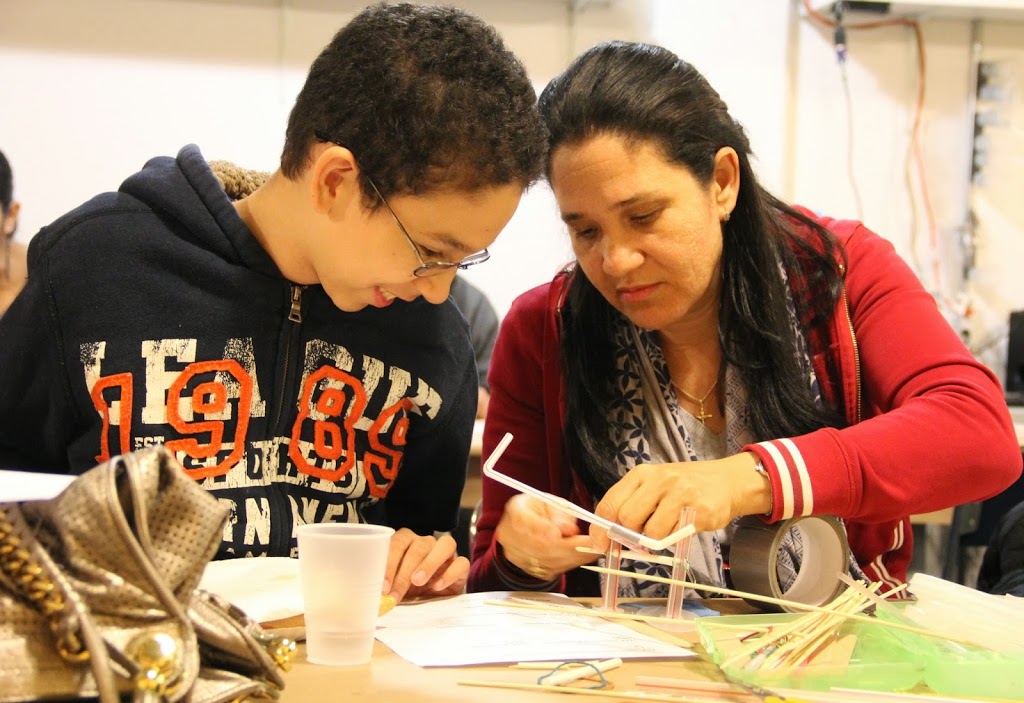
Over the past seven years of working with thousands of children and parents, one truth has emerged – that parents are the ideal science educators.
Science – contrary to how it is taught in many schools – is actually a creative pursuit – just like painting, writing and music. The basic steps are as follows:
The skills you develop after so many hours of practice are critical life skills: curiosity, creativity, problem solving, critical thinking, courage and persistence. The combination of these skills is what sets apart leaders in different fields – writing, painting, sports, music, research, hi-tech or engineering.
Science at school
Schools lay a terrific foundation for scientific learning. However, the structure and prioritization means it's very difficult to support this kind of creative pursuit of each child, over many years. One teacher cannot provide ongoing individual feedback to 20+ students with 20+ unique projects, while also ensuring they learn the fundamental material that provides the vocabulary and conceptual knowledge they need to understand the world.
Prioritization is necessary in this system, and science is taught as a collection of known facts and recipes. Many children go through school thinking that almost everything is known about the world around them or that there are a series of definite steps that need to be followed while doing science.
Herein lies the opportunity for parents – to pick-up the baton and carry it on a long journey of true discovery with their kids, bringing to life the foundational concepts that may have sparked their imagination.
Parents as the ideal science educators
"Children spend much more time at home than at school. Their parents know them intimately, interact with them one-to-one, and do not expect to be paid to help their children succeed. The home environment offers 'teachable moments' that teachers can only dream about." –David Peterson
The home environment is a wonderful sandbox for children to nurture creativity, critical thinking and courage. Parents are also very used to playing and being children themselves. Thus they can learn alongside their children, make mistakes, fail, get up and try again – modeling the scientific process authentically.
They can also connect learning fluidly across different mediums and environments – reading, cooking, gardening, playing with toys, hiking, traveling and shopping.
Unanswered questions can become the norm, not the exception, since the emphasis can be on an open-ended process of model building rather than on the elaboration of a mass of "known" facts.
Finally, many parents have the opportunity to provide continuous support for almost 18 years. The routine at home can prove to be a stable anchor for scientific exploration. For instance, families devote significant resources to the practice of sports after school and on Saturday mornings over 5-10 years (1000-2000 hours). A similar number of hours spent on the weekend in pursuit of a problem or engineering project can result in the development of impressive critical thinking abilities that may even lead to the child contributing an original and valuable solution to the world's knowledge base.
Below are some ideas to help you get started at home.
Cooking experiments
Questions to ask while walking in the garden or going on a hike
Copyright 2026 Technovation. All Rights Reserved
in the United States


