
If you do a Google search for "Role Models", you get 5 million results. "Mentor" yields 2.6 million results, "STEM mentors" 1.6 million and "Apprenticeship" 2.6 million.
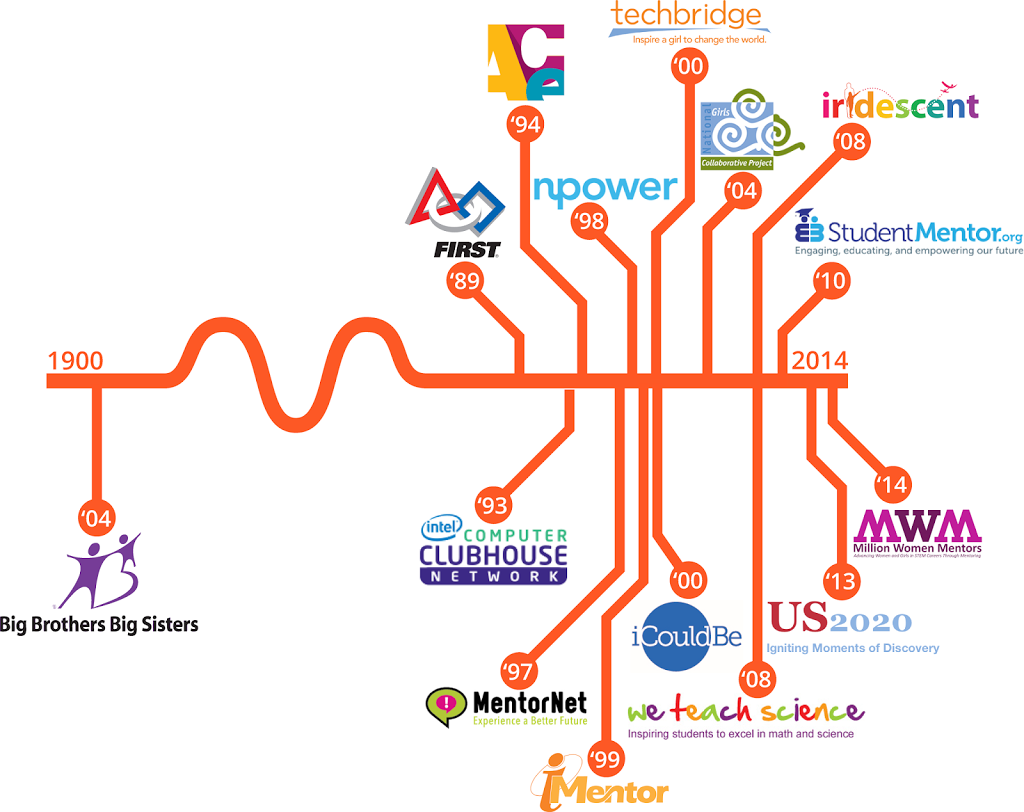
These words (and concepts) are powerful and relevant as we see a big burst of public interest. We put together a graphic in an attempt to make sense of the mentoring organizations (particularly in STEM) that we bump into frequently. We wanted to compile best practices, lessons learned, latest research stats from these organizations and tease out patterns and recommendations for the field. The graphic above is one of the lenses we used.
Mentoring organizations that are active today.
Most of the organizations fall within the past 30 years. Organizations such as Girls Inc., began as Girls Clubs of America in 1945, changed structure and evolved over time to respond better to the changing needs of youth.
Today there is also a rise in efforts to aggregate and share mentoring opportunities across the country, such as with the Million Women Mentors initiative and US2020. But the most prominent 20th century pioneers in the mentor landscape is Big Brothers and Big Sisters. Before 1900, mentoring was just called something different. It was called apprenticeship.
The biggest difference between apprenticeship then and now is that traditional "Michelangelo"-style apprenticeships taught skills that were visible (such as sculpting, painting, Taekwondo or any other martial art form, woodworking). The process of carrying out the task was visible both to the apprentice and master, for observation, comment, refinement, and correction. [Collins et al 1987].
Today, the apprenticeship model has evolved to teach the cognitive processes experts use to handle complex tasks. In the "cognitive apprenticeship" model experts/mentors impart both factual and conceptual knowledge in a variety of contexts, encouraging both a deeper understanding of the meaning of the concepts and facts themselves and a rich web of memorable associations between them and problem solving contexts. It is this dual focus on expert processes and situated learning that makes mentoring such a valuable solution for educational problems of "brittle skills and inert knowledge".
A lodestar in this area has been the research by Allan Collins, John Seely Brown and Susan E. Newman (1987). They identified the following characteristics of an ideal learning environment and surprisingly – by introducing mentors – it is possible to create just such an ideal learning environment – at scale.
While most mentoring organizations share these learning environment characteristics, we have profiled at least one for each to provide an example of how this framework is being currently practiced in the field.
Domain knowledge – conceptual and factual knowledge generally found in school textbooks, class lectures, and demonstrations.
Heuristic strategies – are generally effective techniques and approaches for accomplishing tasks that might be regarded as "tricks of the trade'".
Control strategies – As students acquire more heuristics for solving problems, they encounter a new management or control problem: how to select among the various possible problem-solving strategies, how to decide when to change strategies, and so on. For instance, a strategy for solving a complex problem might be to switch to a new part of a problem, if one is stuck on another part.
Modeling, Coaching, Scaffolding and Fading – are the core of cognitive apprenticeship and help students acquire cognitive and metacognitive skills through observation and guided practice.
Articulation and Reflection – methods designed to help students both focus their observations of expert problem solving and gain conscious access to (and control of) their own problem-solving strategies.
Exploration – The final method (exploration) is aimed at encouraging learner autonomy, not only in carrying out expert problem solving processes, but also in defining or formulating the problems to be solved.
Increasing complexity – refers to the construction of a sequence of tasks and task environments or microworlds where more and more of the skills and concepts necessary for expert performance are required
Increasing diversity – refers to the construction of a sequence of tasks in which a wider and wider variety of strategies or skills are required.
Global before local skills – Students learn to build a conceptual map, before attending to the details of the terrain. For instance, in a tailoring apprenticeship, apprentices learn to put together a garment from precut pieces before learning to draw and cut out the pieces themselves.
Situated learning – A critical element in fostering learning is to have students carry out tasks and solve problems in an environment that reflects the multiple uses to which their knowledge will be put in the future.
Culture of expert practice – refers to the creation of a learning environment in which the participants actively communicate about and engage in the skills involved in expertise, where expertise is understood as the practice of solving problems and carrying out tasks in a domain.
Leveraging cooperation – refers to having students work together in a way that fosters cooperative problem solving. Learning through cooperative problem solving is both a powerful motivator and a powerful mechanism for extending learning resources.
Leveraging competition – refers to the strategy of giving students the same task to carry out and then comparing what each produces. One of the important effects of comparison is that it provides a focus for students' attention and efforts for improvement by revealing the sources of strengths and weaknesses. However, for competition to be effective, comparisons must be made not between the products of student problem solving, but between the processes.
The above framework is just one way to look at the exciting landscape of mentoring organizations. But it does explain why a combination of digital technology and mentors can be such a powerful solution to today's educational problems.
Mentoring organizations today are pushing the boundaries of technology (through various forms of virtual mentoring) to maximize the mentor's time and expertise and craft ideal learning environments.
"Perhaps less obviously, we believe that the core techniques of modelling, coaching and fading can be formalized and embedded in tomorrow's powerful personal computers, thereby fostering a renewal of apprenticeship-style learning in our schools."
"We believe the thrust toward computer-aided learning is an important development in education for several reasons. First, computers make it possible to give more personal attention to individual students, without which the coaching and scaffolding of apprenticeship-style learning are impossible."
"Appropriately designed computer-based modelling, coaching, and fading systems can make cost-effective and widely available a style of learning that was previously severely limited. Of course, apprenticeship-based computer systems need not take on the total responsibility. Instead, they only need to augment the master teacher in a way that amplifies and makes her efforts more cost-effective." [Collins et al 1987]
(Graphic created by Audra Torres. Data gathered through interviews with senior leadership at organizations whenever possible. Interviews were conducted by Andrew Collins, Mentor Community Manager at Iridescent. This article is the first in a series of three. The following articles will look more closely at the depth and type of impact each organization is having as well as organizations focused on engaging girls).
This article has also been published on LinkedIn Pulse and the Huffington Post.
Copyright 2026 Technovation. All Rights Reserved
in the United States


