
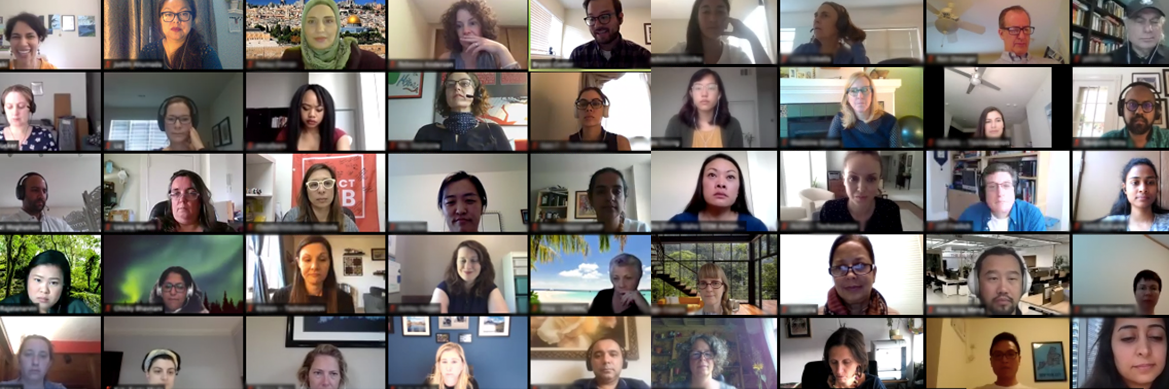
In late June, Technovation convened a Global Online Education Task Force to discuss how to make STEM education more accessible and equitable online. We invited educators, mentors, foundations, community partners, UN agencies and researchers from all around the world to join us. 70 people from 55 organizations gathered online to share and learn from each other's expertise.
Participants split into working groups to discuss best practices for online learning and teaching, supporting parents and teachers as partners in education, establishing strong mentorship connections, addressing inequalities in education, and best practices for measuring impact.
Within those working groups, we discussed the following questions.
We discussed our experiences and ideas, asked additional questions and identified areas that we collectively felt worthy of follow-up.
A note on the scope of this post and the taskforce – although the focus of the taskforce is online learning, we did have thought-provoking conversations about the limitations of online learning for families and educators in areas with limited access to resources including the internet, adequate space, technology and time. We summarized our entire conversation, including those thoughtful comments, in our recap, but for the purpose of this summary will be focusing on recommendations for areas with sufficient internet bandwidth and technology access to support some degree of online learning.
Although each group focused on a different aspect of online education, at the root of each discussion was the question of how to better nurture students to become self-directed learners in an online environment. While circumstances and access to resources dramatically impact how effective online learning can be, we also discussed how critical it is to build strong distance learning partnerships between parents and teachers to create a network of support.
Our teacher and parent and online learner groups both discussed ways to support parents and teachers in connecting with each other. This can include finding ways for teachers and parents to connect about children's progress and concrete ways parents can reinforce learning at home.
To those last two points about channels of communication and asking families how the resources are working for them, one point that came up in several working groups was the importance of integrating psycho-social support for families into lesson plans.
Building a sense of community and collaboration is also vital – we discussed the potential power of establishing regional clusters that can offer blended online/offline support for students.
We also discussed ways to incentivize learning and participating in online learning environments and communities for both parents and students. The first point that came up was straightforward and critical: don't make assumptions about what kids and adults need as incentives – ask.
That being said, the group generated some ideas for incentives to explore with parents and families. Creating opportunities for young people to work on real world problems came up several times. Setting up long-term projects that allow students to focus on their local communities and step into leadership roles is an effective way to help students both direct their own learning as well as engage more directly with their work. The tangible aspect of working on a problem they face every day helps students develop problem-solving and critical thinking skills in a hands-on way. And at a time when so much is uncertain and we are adapting lessons to new formats and mediums, the potential to fully explore project-based learning and experiment with students directing their own projects is high.
The resilience built by troubleshooting problems as they arise, iterating on ideas in light of peer and community feedback, and the immediate, tangible connection to a problem students confront daily foster learning and connection to the learning process.
Supporting students through such projects might look different for each community, but the group discussed that support might be…
In partnership with UNESCO's Global Education Coalition, Technovation ran a pilot program to test out some of the ideas and tools we discussed during the Taskforce meeting. The first pilot program was for girls aged 10-18 living in Brazil, India, Kenya, Mexico, Nigeria and Pakistan. Participating girls learned what AI is, how it works, and made a plan for an AI invention that solves a problem they will have identified in their community. They also learned how to build their own AI model.
The goal of this pilot was to empower and support girls in self-directed technology entrepreneurship programs while also involving industry mentors to serve as role-models and further engage girls throughout the multi-week program. We will be sharing the findings of this pilot publicly and with the Global Education Taskforce.
The next Global Education Taskforce meeting will be September 24, 2020. If you are interested in joining, you can sign up here.
As part of our first Taskforce meeting, Technovation compiled pre-reading for each working group. This reading provided a common framework as a starting point for discussions – including theoretical background and a brief review of what work has been done in each area. Each working group's pre-reading is linked below, if you would like to explore and learn more.
Online Learning & Teaching
Parents & Teachers
Mentors
Inequalities
Impact Assessment
Copyright 2026 Technovation. All Rights Reserved
in the United States


